|
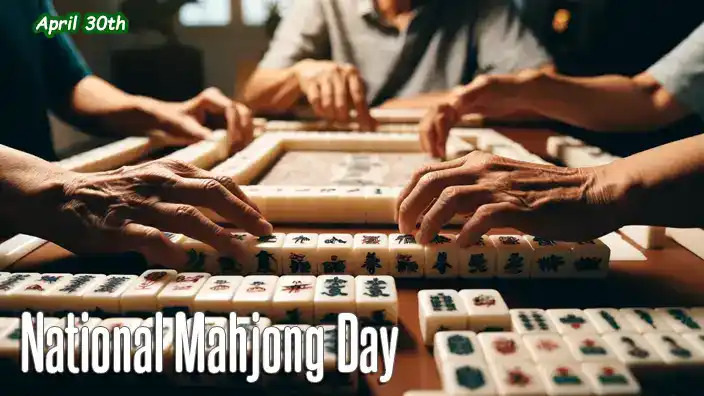
National Mah Jongg Day is celebrated annually on April 30. No matter how you spell it, Mah Jongg is a tile-based game that has been around since its advent in the 19th century in China, and it remains popular all over the world, but especially so in Asian countries and communities. Traditionally, it’s a four-player game, though there are some three-player variations in China, Japan, South Korea, and Southeast Asia. The game is played with a set of 144 tiles originally based on Chinese characters and symbols. In the beginning, each player is given 13 tiles, and their objective is to draw and discard tiles until they complete a legal hand, using the 14th drawn tile to form four sets and a pair (known as ‘melds’ and ‘eye’), respectively.
Mah Jongg is based on card games popular in China in the 18th and 19th centuries, such as Khanhoo and Pènghú, which are Mah Jongg’s most likely ancestors. They’ve been compared with the western card games Conquian and Rummy, as they all involve drawing and discarding cards to make melds. Nobody is sure when the conversion from cards to tiles happened, but it’s estimated to have happened in the middle of the 19th century. The earliest surviving tilesets date from around 1870 and were found in Fuzhou, Shangai, and Ningbo. These sets were different from the ones used today in several ways — some tiles were missing and some were placed differently, others shared the titles of the leaders of the Taiping Rebellion. (It’s believed that they were removed after the rebellion ended.)
On October 1, 1949, the People’s Republic of China was founded. One of their new laws was a ban on gambling, which resulted in a decline in the game. The game became altogether illegal during the Cultural Revolution of 1966. The ban wasn’t lifted until 1985. Nowadays, the game has become a favorite pastime in China.
In the West, the first records about Mah Jongg come from the papers of British Consul General F. E. B. Harvey, from when he served as consul in Ningbo, in the 1860s. He became an acquaintance of an English-fluent official under the Daoguang Emperor, who taught him the game. He then described the rules of the game in a series of papers.
In 1920, Mah Jongg sets began to be imported to the U.S., and it became a fad for the rest of the decade. It became a central part of cultural bonding for Chinese Americans in the 1920s and ’30s, in Chinatown, Manhattan, and was part of community building for suburban American Jewish women in the 1940s and ’50s. Mah Jongg nights in America often involved dressing and decorating rooms in Chinese style. The rules of the American variant became standardized with the formation of the National Mah Jongg League in 1937. In 1986, the N.M.J.L. conducted its first Mah Jongg Cruise Tournament. In 1999, a second organization was formed, the American Mah Jongg Association, which currently hosts tournaments all across North America.
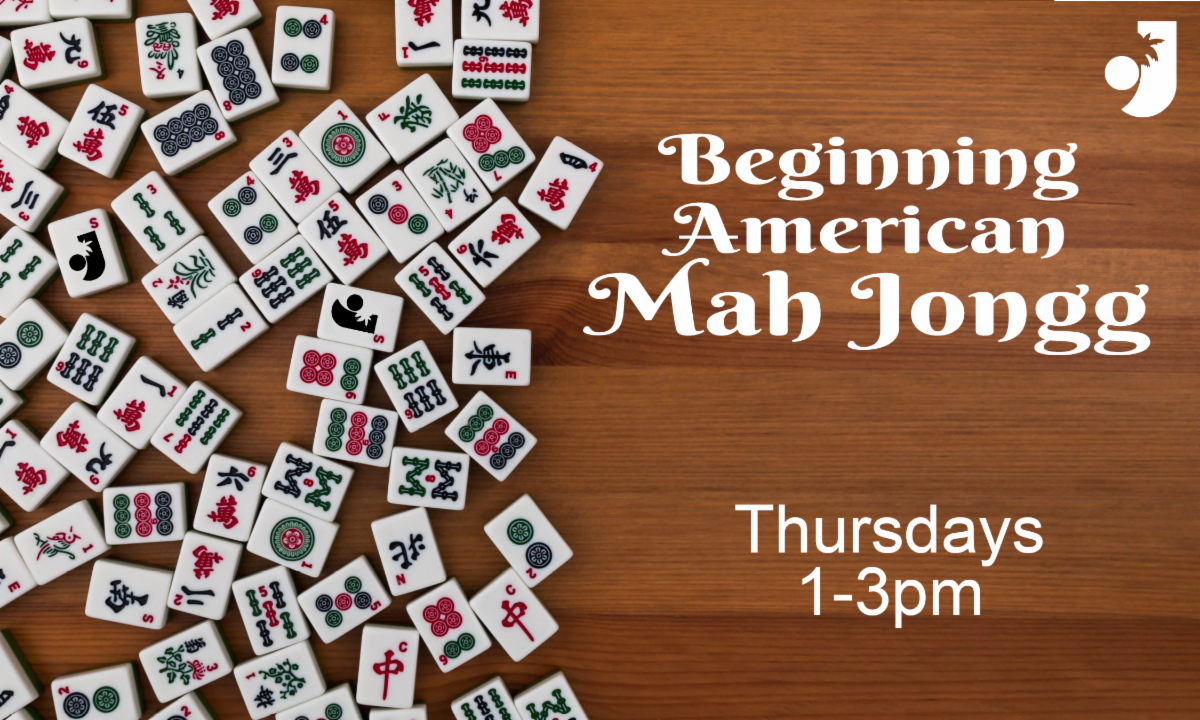
American Mah Jongg is played at Joslyn on Thursday afternoons. Although there is no instructor at the moment, they are looking for new players who already have knowledge on how to play. Chinese Mah Jongg is just starting a group. They say that you can come and watch and they will give you tips on the game. If you are a Mah Jongg player or want to join in, please come to Joslyn on Thursdays. Even better than just playing, if you have the knowledge of the game and would like to be an instructor for either the American or Chinese version, or know someone else who would, please contact our Program Director, Alex Garcia at AlexG@JoslynCenter.org or 760-895-4552.
|